
HENSOLDT and HAL co-develop LiDAR-based helicopter safety system in a collaboration that reflects Europe’s evolving industrial posture
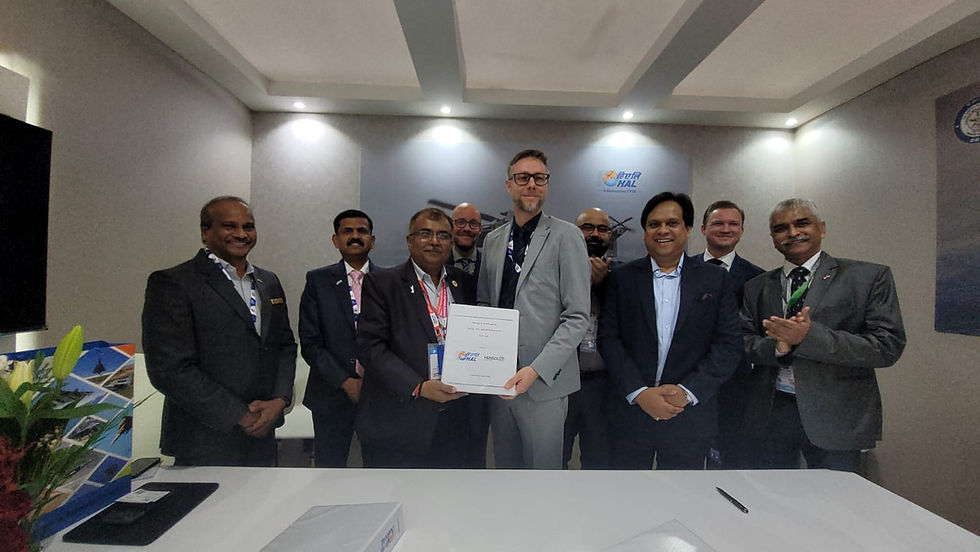
Europe’s aerospace and defense sector is undergoing a phase of strategic reassessment. A combination of global instability, supply chain vulnerabilities, and rising demand for mission-critical technologies has pushed European governments and industry to pursue broader and more diversified capability-building. Against this backdrop, the Indo–German announcement at the Dubai Airshow 2025 of a co-developed LiDAR-based Obstacle Avoidance System (OAS) for military helicopters assumes significant relevance.
Jointly developed by Hindustan Aeronautics Limited (HAL) and HENSOLDT, the program goes beyond a routine avionics upgrade. It reflects how European defense companies are adapting to the realities of Germany’s Zeitenwende—the strategic turning point in Berlin’s foreign and security policy—and the accompanying industrial and geopolitical recalibration. The project embodies an approach centered on shared development, distributed production, and resilient supply chains.
A Technology Aligned With Global and European Needs
The OAS addresses a well-known risk affecting helicopter fleets worldwide: survivability in degraded visual environments and complex terrain. Traditional aids, including night-vision equipment and infrared sensors, provide limited assistance when pilots encounter thin wires, narrow poles, or sudden terrain transitions. CFIT (Controlled Flight Into Terrain) remains one of the leading causes of military helicopter incidents in several countries.

The Indo–German system integrates HENSOLDT’s SferiSense LiDAR Sensor Head Unit—built around a patented fiber scanner capable of achieving a detection probability of ≥99.5% within the first second and detecting obstacles beyond 1,000 meters—with a Degraded Visual Environment (DVE) Computer that delivers synthetic vision and 3D conformal symbology. The architecture mirrors capability trends emerging across Europe, where high-fidelity LiDAR-based sensing and synthetic visualization are rapidly becoming baseline requirements for next-generation rotary-wing operations.
Co-Development Shaped by New Industrial Imperatives
HENSOLDT’s role extends far beyond supplying sensors; the company is co-developing the system with HAL under a built-to-spec model. Technical parameters are being refined jointly to suit Indian operational environments ranging from high-altitude valleys to desert dust and humid littorals. Planned technology transfer—including design and manufacturing IPRs—will enable HAL to manufacture, integrate, and sustain the system domestically, while HENSOLDT maintains a long-term engineering and technology presence.
For European aerospace observers, this collaboration reflects a broader industrial trajectory: European technology firms are increasingly willing to work with high-capability Indo-Pacific partners through shared IP, co-engineering, and distributed production models.

Operational Logic and Phased Integration
The OAS is likely to be integrated into Indian indigenous rotary-wing platforms such as the Light Combat Helicopter (LCH), designed for operations in narrow, high-altitude corridors where atmospheric instability and limited visibility challenge pilot awareness, and the Advanced Light Helicopter (ALH), designed and developed by HAL.
Implications for Europe’s Defense Sector
The Indo–German OAS project offers several key insights for European defense industries.
First, it demonstrates how European firms can strengthen their global relevance by combining engineering leadership with co-development and manufacturing partnerships abroad. This approach enhances industrial resilience by reducing single-point supply chain vulnerabilities.
Second, the program shows how European sensor-technology companies can shape avionics ecosystems beyond their home markets. LiDAR-based systems, synthetic vision, and open-architecture avionics are becoming international standards, positioning European firms as central players in their expansion.
Third, the agreement highlights a model of engineering-driven export collaboration. HAL will hold export rights for OAS-equipped helicopters, meaning European-origin technology integrated into Indian-built platforms may enter markets where European OEMs face cost or delivery challenges.
A Partnership Rooted in Zeitenwende
Germany’s Zeitenwende has pushed Berlin to reassess not only defense spending but also the geography of its strategic partnerships. India, with its growing aerospace capacity, domestic manufacturing scale, and expanding role in Indo-Pacific security frameworks, has emerged as a natural partner.
For India, the collaboration aligns with its effort to move beyond assembly work toward deeper involvement in avionics design, systems integration, and export-ready solutions. Although modest in scale, the OAS initiative demonstrates how co-development can strengthen capability-building while opening new pathways for both sides.
The result is a partnership shaped not only by shared interests but also by shared capabilities. As Europe navigates a transformed security environment, initiatives like the HAL–HENSOLDT OAS may become increasingly common, marking a new chapter in cross-continental defense collaboration built on technology, trust, and long-term industrial alignment.



Comments