
OPINION | Nuclear Pakistan, Saudi Pact, Iran in the Middle: The Question Nobody Will Answer
by Ashu Mann
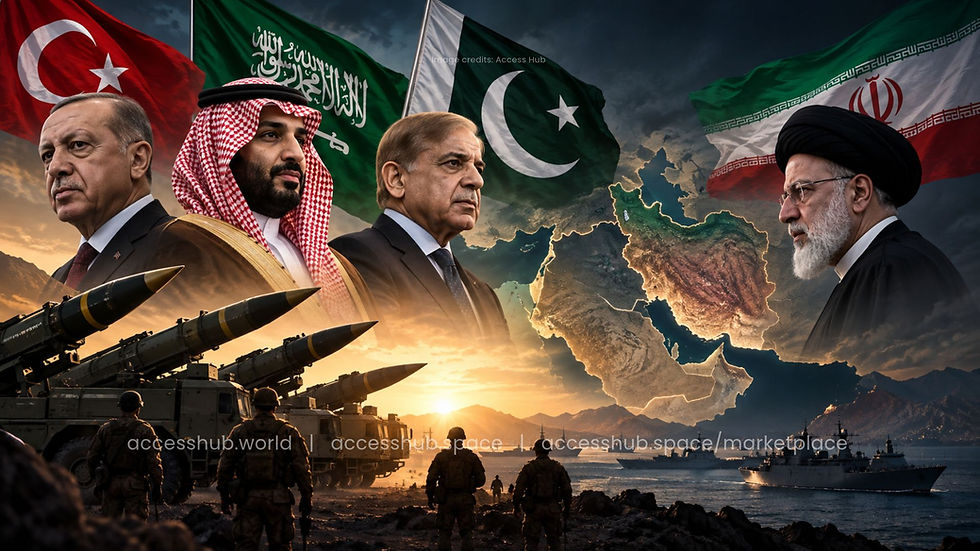
No published text or official statement says that the Mecca Joint Defense Agreement extends Pakistan's nuclear weapons capabilities to Saudi Arabia or Turkey. However, no official has ruled out the possibility either. This leaves the question to be examined through the surrounding evidence rather than the agreement itself.
The three leaders who signed the agreement on August 7, 2026, pledged to strengthen collective deterrence against any act of aggression and agreed that an armed attack on one member would be considered an attack on all. Turkey's Defense Ministry later outlined the practical mechanisms for cooperation, including ministerial meetings, joint exercises involving land, naval, and air forces, and defense industry collaboration prioritizing unmanned systems, electronic warfare, and artificial intelligence. None of these provisions refers to unconventional weapons.
The question arises because Pakistan is the only nuclear-armed member of the agreement. AFP framed the pact in these terms, describing it as a combination of NATO's second-largest army, the Islamic world's only nuclear-armed state, and the leading Gulf power. There is also a precedent in the Saudi-Pakistan Strategic Mutual Defense Agreement, signed on September 17, 2025. A senior Saudi official described the agreement to Reuters as a comprehensive defense arrangement encompassing all military means, without mentioning nuclear sharing. Analysts and some Pakistani diplomats have long suggested that Saudi Arabia could benefit from a Pakistani nuclear umbrella. Crown Prince Mohammed bin Salman has also stated that the kingdom would pursue a nuclear weapon if Iran acquired one.
Pakistani officials have described the Mecca pact in defensive terms and have not linked it to Iran. On September 10, Foreign Ministry spokesman Sajjad Haider Khan said the agreement was a defensive alliance with no plans for expansion. No Pakistani official has connected the country's nuclear arsenal to Tehran.
The activation of the agreement on October 5 followed Houthi missile and drone attacks on Saudi Arabia. It committed the three countries to the rapid deployment of agreed forces and capabilities, although no specific numbers were provided. Announcing the decision, Saudi Defense Minister Prince Khalid bin Salman spoke about confronting attacks on the kingdom and its holy sites without mentioning nuclear weapons. Turkish President Recep Tayyip Erdogan told Newsweek that Turkey's support could include intelligence, logistics, or ammunition, while Foreign Minister Hakan Fidan referred to technical support. Every public statement associated with the activation describes conventional military assistance.
Iran enters the discussion because of geography and diplomacy. Pakistan shares a border of approximately 900 kilometers with Iran and has played a mediating role in the US-Iran conflict. It hosted talks on April 12 and 13 and helped broker the Islamabad Memorandum of Understanding on June 17. The memorandum opened a path toward discussions on Iran's nuclear program, sanctions relief, and maritime security.
Tehran has not accused Pakistan of engaging in nuclear signaling. In response to the agreement's activation, Iranian Foreign Minister Abbas Araghchi called on neighboring countries to pursue self-reliance and genuine brotherhood, adding that agreements of this kind would not constrain Iran, according to Iran International. He made no reference to Pakistan's nuclear arsenal.
Analysts continue to revisit the issue because the military balance between the three countries raises questions about the pact's practical value. Pakistan has the largest standing military force among the three, with 660,000 personnel, but the smallest defense budget at $9.1 billion, compared with Saudi Arabia's $63.9 billion and Turkey's $51.4 billion. Dania Thafer of the Gulf International Forum has argued that Riyadh wants the pact to evolve from a political declaration into a credible deterrent.
However, the Foundation for Defense of Democracies argues that defensive deployments alone are unlikely to deter the Houthis. This suggests that the immediate challenge addressed by the agreement's activation concerns missiles and drones launched from Yemen, rather than a nuclear scenario.
The answer could change if a protocol, ministerial statement, or parliamentary document explicitly defined the agreement's obligations. Turkey's parliament has not yet ratified the pact, and ratification was reportedly expected in October. That process could produce a more detailed public text for the first time, potentially clarifying whether the agreement carries any obligations beyond conventional defense cooperation.
About the Author
Ashu Mann is an Associate Fellow at the Centre for Land Warfare Studies. He was awarded the Vice Chief of the Army Staff Commendation Card on Army Day 2025. He is pursuing a PhD in Defence and Strategic Studies at Amity University, Noida. His research focuses include the India-China territorial dispute, great power rivalry, and Chinese foreign policy.
Disclaimer: This article represents the author’s independent analysis and perspective based on publicly available information. It does not constitute official guidance, intelligence assessment, or policy recommendation, and does not reflect the positions of Access Hub or any affiliated entities.


Comments