
DARPA Selects Benchmark Space Systems for Lunar Water Mapping Mission Study
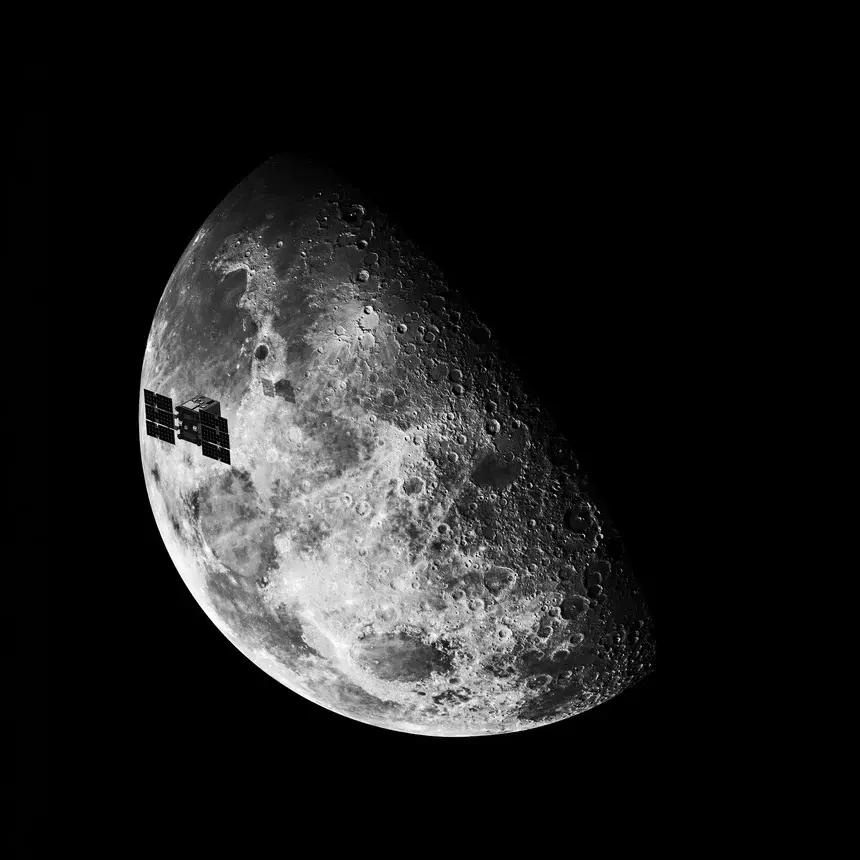
In a significant step toward unlocking the Moon’s resource potential, Benchmark Space Systems has been selected by DARPA to conduct a Phase 1A/1B feasibility and design study under the Lunar Assay via Small Satellite Orbiter (LASSO) program.
At its core, the LASSO initiative aims to answer one of the most strategic questions in the emerging cislunar economy: how to reliably map and access lunar water resources from extremely low lunar orbits, one of the harshest operational environments in space.
Engineering at the Edge of Lunar Orbit
Operating in very low lunar orbit (LLO) is far from routine. The Moon’s uneven gravitational field and rugged terrain create a highly unstable environment that demands precision navigation, advanced propulsion, and real-time autonomous decision-making.
Benchmark, alongside its partners, will assess:
Mission feasibility in sustained LLO operations
Autonomous navigation performance in gravity-distorted conditions
Spacecraft architecture readiness for extreme lunar environments
This study is not just theoretical, it directly informs the viability of future missions that will depend on high-resolution sensing and localized resource identification, particularly water ice.
Sapphire: From Propulsion to Full Mission Architecture
The LASSO selection signals a strategic evolution for Benchmark, from a propulsion specialist to a mission architecture provider.
At the center of this transition is the company’s Sapphire architecture, a next-generation spacecraft concept designed for demanding orbital regimes.
Key capabilities under evaluation include:
Hybrid propulsion systems combining high-thrust chemical engines with efficient electric propulsion
Autonomous terrain navigation and hazard avoidance
Delta-V optimization for sustained maneuverability in unstable orbits
DARPA has already identified hybrid propulsion as a critical enabler for credible LLO missions, reinforcing the relevance of Benchmark’s approach.
This award also builds on Benchmark’s growing portfolio with U.S. government agencies, including collaborations with NASA and the Air Force Research Laboratory on advanced orbital transfer vehicle programs.
Why LASSO Matters for the Future of the Moon
LASSO is more than a feasibility study, it is a technology pathfinder for sustained lunar operations.
By pushing spacecraft capabilities into very low lunar orbit, the program aims to:
Enable high-resolution mapping of lunar resources, particularly water ice
Support future lunar logistics and infrastructure development
Strengthen cislunar domain awareness for civil, commercial, and defense stakeholders
Crucially, Phase 1 focuses on reducing technical risk and validating architectures early, ensuring that future missions are not only ambitious, but executable.
Strategic Implications: From Feasibility to Cislunar Advantage
Benchmark’s selection reflects a broader shift in the space ecosystem: the convergence of propulsion, autonomy, and mission design into integrated capabilities.
As nations and private players accelerate their lunar ambitions, the ability to operate in extreme orbital regimes will define competitive advantage. Programs like LASSO are laying the groundwork for:
Persistent lunar presence
Resource-driven exploration
Strategic positioning in the cislunar domain
As Ryan McDevitt, CTO of Benchmark Space Systems, noted:
“Demonstrating viability at this stage is a critical milestone toward enabling future cislunar activity.”


Comments