
OPINION | The Long View for French Armed Forces: Space Investment as Strategic Foresight
by Omkar NIKAM
The French Armed Forces maintain one of the most complex and geographically dispersed military postures in the world. With nearly 30,000 military personnel deployed across four continents simultaneously, operating from the Caribbean to the Pacific, from the Baltic to the Horn of Africa, France faces an unprecedented command and control challenge. These forces operate in the scorching deserts of the Sahel, the dense jungles of French Guiana, the congested sea lanes of the Mediterranean, and the contested airspace over Eastern Europe. Behind every mission, every communication, and every tactical decision lies an invisible infrastructure that has become as vital as ammunition itself: France's military space architecture. Satellites orbiting 20,000 kilometers above Earth have evolved from force multipliers into the indispensable nervous system of French military power. Without this space-based capability, France's global military presence would face immediate operational paralysis.

France's current operational commitments reveal a military posture of staggering complexity. This isn't the warfare of concentrated armies meeting on defined battlefields. This is simultaneous, multi-domain, globally distributed operations that would have been unimaginable just two decades ago. And increasingly, it's becoming clear that without revolutionary investment in space-based applications, France, and indeed any nation with serious security ambitions, risks operational paralysis in the conflicts of tomorrow.
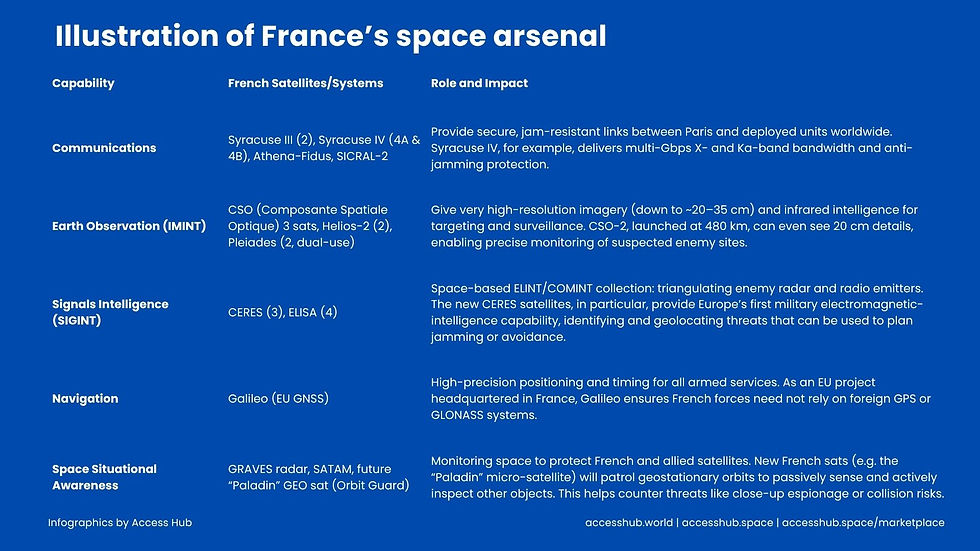
A quick summary to illustrate the scope of France’s space arsenal:
The Geography of Modern French Military Commitment
To understand why space applications are not merely beneficial but existential for modern military operations, we must first grasp the sheer scope of France's operational commitments. The current deployment paints a revealing picture:

This distribution represents more than numbers on a spreadsheet. Each deployment zone presents unique operational requirements: real-time intelligence in the Sahel to track terrorist movements, precision navigation for maritime interdiction in the Gulf of Guinea, secure communications for special operations in Iraq, weather forecasting for aviation missions in the Baltic, and continuous surveillance of French territorial waters spanning three oceans.
The Satellite Imperative: Five Critical Functions
The complexity of these operations creates five non-negotiable requirements that only space-based systems can fulfill:
1. Communications Beyond Terrestrial Limits: When French forces operate in Djibouti, the Central African Republic, and Estonia simultaneously, traditional communication infrastructure becomes meaningless. Military satellites provide the only reliable means of secure, real-time communication across such distances. Consider the operational reality: a command decision made in Paris regarding Operation CHAMMAL in Iraq must reach deployed units within minutes, perhaps seconds, despite terrestrial networks being unavailable, unreliable, or compromised.
The 2,650 military personnel in French Guiana operate in one of the most communication-hostile environments on Earth, a dense rainforest canopy where terrestrial signals are absorbed within meters. Satellite communications aren't an enhancement here; they're the only option. Multiply this across sovereignty forces spanning 9,050 personnel across five territories, and the scale of the communications challenge becomes evident.
2. Intelligence, Surveillance, and Reconnaissance (ISR): The 950 French personnel deployed in Operation CHAMMAL require constant intelligence updates about ISIS remnants, weapons movements, and potential threats. But intelligence collection in modern counterterrorism isn't about fixed positions; it's about tracking patterns across thousands of square kilometers, identifying anomalies in vehicle movements, detecting clandestine training camps, and monitoring border crossings.
Only satellite-based ISR can provide this coverage. Optical reconnaissance satellites offer resolution capable of identifying vehicle types from orbit. Synthetic Aperture Radar (SAR) satellites penetrate cloud cover and operate at night, crucial for operations in regions like the Sahel, where adversaries exploit weather and darkness. Signals intelligence satellites intercept communications, providing the electronic fingerprints of terrorist networks.

For maritime operations like CORYMBE in the Gulf of Guinea (450 personnel) or anti-piracy missions under EU operation Atalanta (250 personnel), satellite ISR transforms needle-in-haystack searches into targeted interdictions. Automatic Identification System (AIS) data from space tracks vessel movements across millions of square kilometers of ocean, identifying anomalies that might indicate piracy, smuggling, or illegal fishing.
3. Precision Navigation and Timing: Every modern weapons system, from guided artillery to drone operations, depends on Global Navigation Satellite Systems (GNSS). The European Union's Galileo system, in which France is a key stakeholder, provides positioning accurate to centimeters, essential for operations requiring precision engagement while minimizing collateral damage.
But navigation extends far beyond weapons guidance. Troops operating in featureless deserts of the Sahara or dense forests of French Guiana depend on satellite navigation for basic movement. Maritime vessels navigating the narrow straits connecting the Arabian Gulf depend on GNSS for safe passage. Aircraft conducting air policing missions over the Baltic as part of NATO commitments rely on satellite timing for coordination.
Perhaps most critically, the timing signals from navigation satellites synchronize communications, intelligence collection, and weapons systems. Modern military operations are exercises in split-second coordination; without satellite-provided timing, this synchronization becomes impossible.
4. Early Warning and Missile Detection: France's nuclear deterrent, the ultimate guarantor of national sovereignty, depends absolutely on early warning satellites. These infrared sensors detect the heat signatures of missile launches anywhere on Earth, providing the minutes of warning that separate effective response from catastrophic surprise.
But early warning extends beyond strategic scenarios. French forces operating in Iraq, Syria, and across the Sahel face threats from shorter-range ballistic missiles and rockets. Space-based infrared sensors can detect these launches, providing tactical warning that allows forces to take cover or activate defensive systems.
5. Environmental Monitoring and Meteorology: Military operations are intensely weather-dependent. The 1,400 French troops deployed to Romania as part of NATO multinational battalions need accurate weather forecasting for training exercises and potential operations. Naval vessels in the North Atlantic (200 personnel) require storm tracking for safe navigation. Air operations across all theaters depend on cloud cover information, wind patterns, and visibility forecasts.
Weather satellites provide this data, but they also serve a broader environmental monitoring role. Detecting dust storms that ground aviation, monitoring sea states for amphibious operations, tracking ice coverage in Arctic regions, and even detecting forest fires near military installations, all depend on satellite observations.
The Strategic Vulnerability: Dependence Without Investment
Here's the uncomfortable truth: France's military effectiveness already depends entirely on space-based capabilities, yet investment in these systems hasn't matched the pace of operational demand or the evolution of threats.

France operates military satellites through the Syracuse program for communications, the CSO program for optical reconnaissance, and contributes to multinational programs like the Helios observation satellites. But these programs face two critical pressures: the accelerating pace of technological change and the emergence of space as a contested domain.

China's demonstrated anti-satellite weapons, Russia's inspector satellites capable of approaching and potentially attacking other spacecraft, and the proliferation of electronic warfare capabilities targeting satellites have transformed space from a sanctuary into a battlefield. Yet France's space defense investments have not kept pace with this transformation.
The Economic and Strategic Case for Massive Investment
The argument for dramatically increased investment in military space applications isn't simply about maintaining current capabilities; it's about preventing strategic obsolescence. Consider three dimensions:
Operational Effectiveness: Every military mission outlined in France's current deployments would face degraded effectiveness or complete failure without satellite support. The 3,150 prepositioned forces in Africa and the Middle East serve as rapid response capabilities, but rapid response becomes impossible without the intelligence that identifies crises, the communications that relay orders, and the navigation that guides forces to their destinations.
The cost-benefit analysis is stark: a single modern reconnaissance satellite costing €500 million provides intelligence coverage that would require hundreds of aircraft, thousands of personnel, and billions in operating costs to replicate through terrestrial means, and even then, the coverage would be incomplete and intermittent.

Strategic Autonomy: Dependence on allies' space capabilities, whether American GPS, multinational satellite programs, or commercial providers, creates strategic vulnerabilities. In crisis scenarios where national interests diverge, France must possess sovereign space capabilities. The Galileo navigation system represents this thinking: a European alternative to American GPS that ensures positioning, navigation, and timing services remain available regardless of U.S. policy decisions.
This autonomy must extend across all space domains. Reconnaissance satellites, early warning systems, secure communications, and space situational awareness, the ability to track and understand what's happening in orbit, must all be under French or European control.
Technological Leadership and Industrial Base: Investment in space applications isn't purely a defense expenditure; it's an investment in a strategic industrial capability. The technologies developed for military satellites, advanced sensors, radiation-hardened electronics, autonomous systems, and precision manufacturing have cascading benefits for civilian space programs, commercial applications, and broader high-tech industries.
France's space industrial base, centered around companies like Airbus Defense and Space, Thales Alenia Space, and Arianespace, represents thousands of high-skilled jobs and billions in economic activity. Allowing this capability to atrophy through underinvestment would inflict strategic and economic harm far exceeding the cost of maintaining technological leadership.
A Roadmap for Space Investment
France must pursue a comprehensive, multi-decade program of space capability development. This should include:
Resilient Satellite Constellations: Moving from a few expensive, vulnerable satellites to distributed constellations of smaller spacecraft that provide redundancy and resilience against attack.
Space Situational Awareness: Enhanced sensors and tracking capabilities to monitor orbital activities, detect threats, and coordinate space traffic.
Defensive and Deterrent Capabilities: Systems to protect French satellites from attack and, if necessary, impose costs on adversaries who threaten French space assets.
Next-Generation Communications: Quantum-encrypted satellite communications that resist electronic warfare and provide unbreakable security for command and control.
Hyperspectral and Advanced Imaging: Reconnaissance capabilities that move beyond visible light to detect camouflaged equipment, identify materials from orbit, and penetrate concealment.
Artificial Intelligence Integration: AI systems that process the torrents of data from satellites, identifying patterns, anomalies, and threats faster than human analysts.
The price tag for such a program would be substantial, likely requiring doubling or tripling current French military space budgets over a decade. But placed in the context of total defense spending and the operational imperatives it serves, this investment becomes not just justified but urgently necessary.
The Path Forward: An Integrated Space Strategy
France's 30,000 deployed military personnel operate in a complex, distributed, and demanding operational environment that is only becoming more challenging. Climate change is expanding operational theaters to the Arctic and creating instability that generates new missions. Great power competition is intensifying across all domains, including space. Technological change is accelerating, creating new threats and opportunities simultaneously.
In this environment, space capabilities aren't auxiliary systems that enhance traditional military operations; they're the foundational architecture upon which all modern military operations rest. Without satellite communications, deployed forces become isolated. Without satellite reconnaissance, commanders operate blind. Without satellite navigation, precision becomes impossible. Without satellite early warning, surprise becomes inevitable.
The lesson is clear: France must treat investment in military space applications not as discretionary spending on futuristic capabilities, but as an essential investment in the infrastructure that enables military effectiveness today and strategic autonomy tomorrow. The 30,000 French military personnel deployed across the globe depend on it. The nation's security requires it. And the window for achieving it is closing.
Space is no longer the final frontier; it's the first line of defense. France must invest accordingly.
About Author

Omkar NIKAM, Founder & CEO, Access Hub
Omkar is a consultant, analyst, and entrepreneur with over a decade of experience advising governments, space firms, defense agencies, aerospace, maritime, and media technology companies worldwide. At Access Hub, he shapes the vision, strategy, and global partnerships, positioning the platform at the crossroads of innovation and business growth.

Comments