
OPINION | Fraud’s Legacy: Delay for Honest Elections Like Nepal
by Ashu Mann
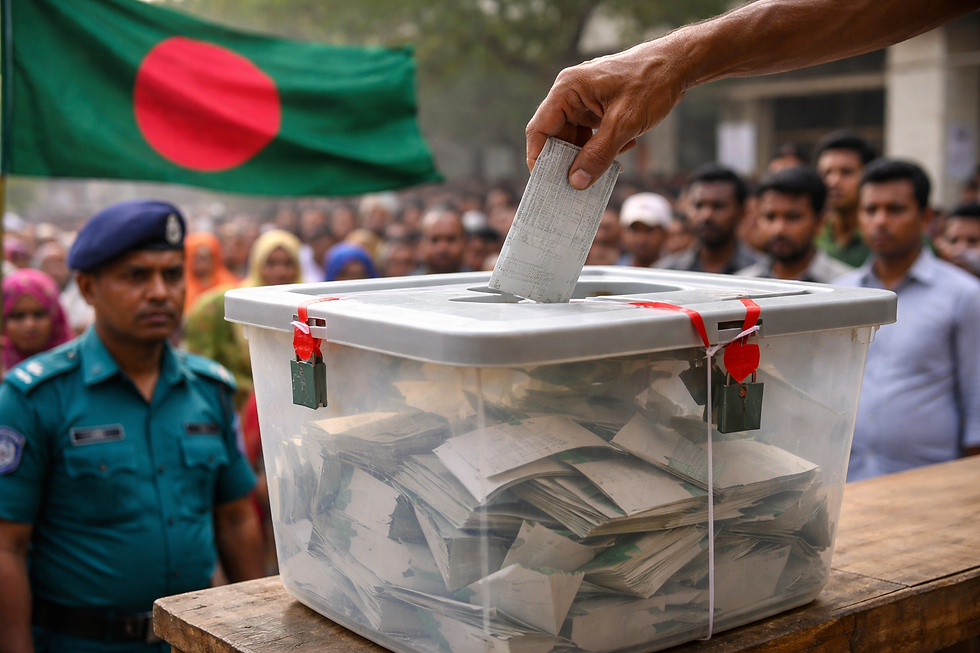
The legacy of the past fifteen years in Bangladesh is not merely one of autocracy; it is one of mathematical deception. The ballot box, once the sacred vessel of the people’s will, was transformed into a magician’s hat where votes appeared and disappeared at the whim of the ruling party. From the strategic vantage points of New Delhi, the current rush to hold the 13th Parliamentary Election on February 12, 2026, looks less like a democratic restoration and more like a relapse into that same deception.
The electoral rolls are tainted. The oversight mechanisms are fractured. Asking the people of Bangladesh to vote within a system designed to cheat them dishonors the memory of those who died fighting for a new nation. The only way to honor their sacrifice is to stop the clock, delay the polls for six to twelve months, and build a system that is fundamentally incapable of lying.
The evidence of decay is not anecdotal; it is empirical. The 2018 election, widely known as the “midnight election,” saw Transparency International Bangladesh document irregularities in 47 of the 50 constituencies it surveyed, including ballot papers stamped and sealed the night before voting in 33 constituencies. These findings were never meaningfully addressed by the Election Commission.
The 2024 election appeared even more farcical. The BNP accused the ruling party of backing “dummy” independent candidates to simulate competition, an allegation the Awami League denied, in a contest where the outcome appeared predetermined. These were not elections; they were theatrical productions.
The voter rolls that supported those exercises remain in use. They continue to face serious concerns regarding integrity and manipulation risks, allowing fictitious or improperly retained names to influence close contests. Even recent roll revision reports in West Bengal, India, a system far more institutionally robust, have flagged large-scale anomalies, including voters wrongly marked as deceased or as non-citizens. Rushing to the polls without a comprehensive, technology-driven re-census risks allowing these distortions to operate once again.
Meanwhile, the oversight machinery remains dangerously weak. The Election Commission has faced controversy and allegations related to procurement practices, including questions about the high cost of Electronic Voting Machines and financial accountability. This is not an institution that inspires confidence in its ability to police itself.
At the ground level, the administrative apparatus has largely remained unchanged. Deputy Commissioners and local police officials who manage voting centers are the same officials who oversaw previous contested elections. They have not undergone structural reform; they have simply grown quieter. Expecting this system to suddenly deliver a fair vote is unrealistic. A delay is essential to replace compromised mechanisms with genuinely independent oversight bodies that derive credibility from civil society and the judiciary rather than inherited loyalties.
Critics of postponement often insist on “immediate democracy,” yet they overlook successful models in the region. Nepal provides a compelling example of strategic patience. After abolishing the monarchy, Nepal did not rush into a fragile electoral exercise. Instead, it engaged in prolonged negotiations and redesigned its electoral framework, introducing a mixed system that combined first-past-the-post with proportional representation to expand inclusion. The process was neither swift nor simple, but it ultimately produced elections accepted by all major political actors. That deliberate transition transformed deep mistrust into a workable democratic consensus.
Bangladesh now stands at a similar crossroads. It can choose the path of expediency and proceed with an election on February 12 that will likely be clouded by familiar allegations of rigging and fraud. That path risks a legitimacy crisis, with losing parties returning to the streets and the cycle of unrest resuming.
Or it can choose the path of strategic pause. It can take a year to conduct a door-to-door biometric re-census, ensuring that every living Bangladeshi, and only every living Bangladeshi, has the right to vote. It can invite international experts to design a tamper-resistant oversight architecture. It can prosecute those responsible for past electoral manipulation, sending a clear signal that election theft carries consequences.
The objective is not simply to hold an election; it is to restore trust. Democracy cannot endure without confidence in the fairness of its system. Today, that confidence has been eroded by years of alleged betrayal. The interim government has a historic opportunity to rebuild it, but not in haste. It needs time. It must communicate clearly that a delay is not a denial of democratic rights, but a defense of them.
Delay the polls. Count the people. Build a system that tells the truth. Only then can the legacy of fraud finally be laid to rest.
About the Author
Ashu Mann is an Associate Fellow at the Centre for Land Warfare Studies. He was awarded the Vice Chief of the Army Staff Commendation card on Army Day 2025. He is pursuing a PhD from Amity University, Noida, in Defence and Strategic Studies. His research focuses include the India-China territorial dispute, great power rivalry, and Chinese foreign policy.


Comments